Posts in Writing

Inevitability in a Lyric

A few years ago, I was in a year-long songwriting mentorship program, and one thing they said over and over was: the real write is the rewrite. I understood it in theory. Or at least I thought I did.

For a long time, I think I took that to mean: make the lyric better. Make it sharper. Find the more interesting phrase. Make it a little more clever, a little more cheeky (maybe I’ve spent too much time with Brits), a little smarter. I liked lines that had a wink in them, lines that made me feel like, okay, that’s a writer line.

But lately, I keep wondering if I’ve been chasing the wrong kind of “better.”

I think part of what has changed is the whole ecosystem around me. Not just one course or one book, but all of it: the reading, the analysis, the writing cohorts, the table reads, the libretto work, the musical-theatre songwriting classes. Those questions are in my head all the time now: What does the character want? What are they not saying? What changes if they finally say it?

And I guess that has started to change how I hear pop lyrics too. Not because I want to strip everything down until it is generic. I don’t. But I am becoming more aware of what the poetic line is actually doing inside the song.

Because I have always been drawn to the slightly obscure. Growing up around Sarah McLachlan and Tori Amos probably did something to my ear. I fell in love with lyrics that were not always literal on first listen, lyrics that felt atmospheric, symbolic, strange, feminine, private, a little haunted. I liked when a line did not give itself away too quickly.

And I still love that.

I do not want to lose the poetic part of myself. I do not want to flatten everything into something generic just because it is easier to understand. But I am learning that obscure only works when it is anchored to emotional truth.

That is where theatre has been quietly rearranging my instincts.

I don’t think I want to choose between poetic and clear. I think I am trying to learn when the poetic is actually serving the song, and when it is just standing there looking like a pretty “pick me” girl.

That is what I started noticing while working on “Beautiful Mistake.”

There was an earlier version of the pre-chorus that went:

These feelings get louder
My head cuts in line
’Cause one moment can change everything.

A few hours later, I threw on my shoes and gave my brain a reset as I walked around the block. This is my typical go-to when I can’t tell if I trust my opinion of my work anymore. I need to stop staring at words on the page so I can actually hear them. The ideas had been sitting somewhere in the back of my mind, doing whatever ideas do when we finally leave them alone.

When I came back to the song, I realized something.

The line was clever.

My head cuts in line

I still think it’s clever. It captures something true about me: the way I can be feeling something intensely while also analyzing it in real time. My head absolutely does cut in line.

But clever isn’t enough.

What about inevitable?

The first version encapsulated a clever idea, but it didn’t feel like a heart-to-heart. It sounded like something I might write after analyzing the feeling, not something I would say while sitting across from a friend or therapist, trying to explain why I couldn’t trust myself with it.

The rewrite felt closer:

My heart would betray me
If I let it lead
Oh, one moment can cross every line…

This one made all the difference.  The first version talked about the conflict. The rewrite put me in the room with it.

And maybe that is the theatre lesson sneaking into my pop writing: the line has to belong to the person singing it, not just to the writer who thought of it.

In “Beautiful Mistake,” a song I have been working on, the singer is not simply sad. She is making a choice. She is holding something back because she understands what acting on it could cost. The song was inspired by People We Meet on Vacation, a movie my daughter raved about until I finally watched it, but what stayed with me wasn’t just the romance. It was the almost aspect of it.  This is a song about restraint and the feeling that one choice could change the shape of everything.

That is drama, even in a pop song.

I think that is the biggest thing this whole ecosystem is teaching me: a lyric has to do something. It cannot just decorate the emotion. It has to carry the pressure of the moment.

The chorus became the place where the song finally told me what it was really about:

Somebody’s gonna see you
Like I never had to try-to
When they love you without leaving
I’ll learn to be alright

That line, “when they love you without leaving,” is where I understood the wound.

This is not a song about not loving someone. It is about loving someone enough to know that wanting them does not automatically give you permission to step closer. It is about the ache of seeing someone clearly and still understanding that your love, if acted on, might ask too much of both of you. It is about wanting them to be loved without absence attached to it. Wanting them to be seen, even if you are not the person who gets to stay.

And that is why the rewrite matters.

I think the first draft often finds the feeling. The rewrite is where I start to find the truth underneath it.

I still love poetic writing. I probably always will. But I am learning that poetry in a song has to earn its place. It has to belong to the voice, the pressure, the moment. Otherwise, it is just pretty.

And I want more than pretty.

I want the line that connects, the line that earns its place, the line that feels like the singer had no other choice but to sing it.

Since this blog is also a place where I share my work, I’m including the full lyric below, not as something finished beyond revision forever, but as a snapshot of where the song is now, and what this particular rewrite taught me.


Beautiful Mistake

Words and Music by Rachel A R Shaw

I won’t rush a feeling
That still has no name
We both know what it’s costing
To keep us this way

I can’t cross the distance
’Cause I’d wanna stay
So these miles decide
How this ends

My heart would betray me
If I let it lead
Oh, one moment can cross every line…

Somebody’s gonna see you
Like I never had to try-to
When they love you without leaving
I’ll learn to be alright
These miles never close
And I hate how much they stay
But the distance keeps us from breaking…
Something so beautiful

So you’ll never be
No, you’ll never be
My beautiful mistake

The world spins me sideways
And I feel it all too fast
One look from you
And I’m a house made of glass

Writing out your name
But I could never click send
I can’t move any closer
To something that ends

I sit in this feeling
Until it runs clear
Some things hit like love, even from here

Somebody’s gonna see you
Like I never had to try-to
When they love you without leaving
I’ll learn to be alright
These miles never close
And I hate how much they stay
But the distance keeps us from breaking…
Something so beautiful

So you’ll never be
No, you’ll never be
My beautiful mistake

Some doors don’t close gently
Some hearts don’t halfway break
And I know enough to know
Just how much I can’t take

Don’t ask me if I’m fine
I’m just better at goodbye

You’ll never be
No, you’ll never be
No, you’ll never ever be…

My beautiful mistake

© 2026 Rachel A. R. Shaw. All rights reserved.

Inspired by People We Meet on Vacation

Taking a Swing at Tin Pan Alley: How a Photograph Became a Song

Months ago, I was bemused in a musical theatre lyric-writing class with the brilliant John Dietrich, and one of the assignments began with a photograph.

The challenge was simple: study the image and write a song inspired by the world it suggested.

My photograph showed a well-dressed gentleman driving through a polished Connecticut town with his poodle seated proudly beside him. From that single image emerged a comic Tin Pan Alley-style number about gossip, appearances, and the steadfast loyalty of dogs.

In class, we refined the lyric and staged it as a complete scene. What began as a simple songwriting exercise blossomed into a miniature theatrical world: ladies in a beauty salon singing from the windows, slightly tipsy men in a tavern offering their commentary, and a wonderfully clunky tuba blast punctuating the final word: “DOG.”

The piece was inspired by the musical language of Irving Berlin, Cole Porter, and the great Tin Pan Alley songwriters of the late 1920s and 1930s. It uses the classic AABA form, elegant internal rhymes, and a comic ending that deliberately breaks the expected rhyme to land with a musical wink.

One of the things I loved most about studying with John was discovering how quickly a single image could become an entire dramatic world.

A photograph becomes a lyric.
A lyric becomes a song.
A song becomes a scene.

That, to me, is the magic of musical theatre.


High Hats, Low Hearts

An immaculate Connecticut town on a bright morning. A ladies’ salon hums on one side of the street; a tavern stands across the way. Townspeople move with practiced civility, smiling, waving, and quietly minding everyone else’s business.

Light swing — piano and brushed snare.

THE GENTLEMAN glides through town, gloved and ramrod straight, his POODLE perched beside him like visiting royalty. He tips his hat with the easy confidence of a man admired by all and questioned by many.

GENTLEMAN
He drives through town with a gentleman’s flair,
His poodle beside him, proud as an heir.
His wife’s at home — or so they say,
I’ve heard she’s not alone today…

Heads turn. Smiles sharpen. Gossip slips effortlessly into time.

LADIES
Oh, he’s got class, his girl’s got curls,
The envy of the uptown girls.
She’s poised and pretty, loves a treat,
She’s at his side come rain or sleet.

In the salon, women lean toward the window, singing as they set curls and trade opinions. Across the street, tavern regulars tap their mugs in rhythm, eager to add their two cents.

Music softens; upright bass and cymbal brushes.

TAVERN MEN
(taking turns, a bit tipsy)
That wife’s long gone, prolly run off or dead,
She lies beneath the garden bed.
Now it’s just him ’n’ his not-so-stray,
A dog’s love never runs away.

The POODLE spots another dog passing by and nearly launches himself through the window.

GENTLEMAN
When you ask ’em to stay… they stay.

(spoken, mildly) Stay.

The POODLE freezes mid-pounce and sits at once. The town approves.

The swing returns, brighter and just a touch smug.

GENTLEMAN
She’s chasing high hats — a low-heart affair,
Some women play, oh, a harlot don’t care.
Let ladies go mad for a kiss or façade —
He’s better off with his DOG.

On the word DOG, the tuba lands with a gloriously clumsy BLAT in perfect unison with the singer. The note is the joke.

The POODLE leans out the window, tongue wagging, entirely pleased with himself.

Blackout.


The Invisible Work of Making a Book Feel Alive

Picture Books Are Built Through Rhythm, Trust, and Creative Continuity

The Almost Is Where I Almost Ended Up Living

I don’t think I ever set out to start an imprint in some grand, strategic way.

That sounds far more organized than it actually was.

What really happened is that I began making children’s books, and somewhere along the way I realized I cared about too many parts of them to hand the whole thing off and politely wait at the end.

I cared about the words, of course. But I also cared about the page turn. I cared about whether an illustration had enough room around it. I cared about whether a spread felt too loud too soon, or whether a moment that should have felt magical was landing a little flat.

I cared about the rhythm of the book, the visual flow, the emotional temperature of a page. Whether it felt too loud, too flat, too cold, too crowded, or almost right but not quite.

Especially the almost.

The almost is usually where I end up living for a while.

I think that comes from having spent years moving between music, design, writing, scripts, creative direction, advertising and whatever other creative rabbit hole I happened to be living inside at the time.

Drama Is in the Timing

I have always been drawn to how something unfolds. Drama is in the timing, isn’t it? In when something arrives, when it holds back, and when it finally has the nerve to show itself.

That’s true in music, of course. You can feel when something enters too soon. You can feel when a note needs to hang in the air a little longer before the next one answers it. You can feel when a song is pushing too hard to move you, and when it trusts itself enough to simply be.

It’s true in writing too. Sometimes the most important part of a scene is not the line someone says. It’s the little pause before they say it. Or the thing they almost say and swallow instead. Or the moment when everyone in the room knows what is happening, but no one has quite found the courage to name it yet.

And in design, it may be a bit quieter, but it’s still there, you know. It lives in all that space around the image, what the designer in me likes to call negative space. It’s in what gets held back, what gets room to breathe, and what is allowed to arrive slowly.

 Small Worlds a Child Gets to Move Through

So when I began working seriously on children’s picture books, I suppose I brought all of that with me.

I didn’t think of them as little lessons with illustrations attached. That would have bored me immediately, and probably the child too.

I thought of them as small worlds a child gets to move through.

A child is not only reading the words. They’re noticing the face in the corner, the color that suddenly changes, the page that feels busy, the page that goes quiet, the tiny thing you almost hope they catch. They’re feeling the book before they’re analyzing it, which, honestly, is probably the better way to experience most art.

Adults have a way of ruining things by needing everything to announce its purpose.

Children are often better at stepping inside the thing before asking what it is supposed to mean.

I think I was chasing the feeling I had with certain books as a child. Not the memory of the plot, necessarily. More the feeling that the book had a place inside it, and if I opened it again, I could go back.

That is what I loved about picture books as a child. The best ones didn’t explain themselves to me. They let me wander around inside them. They gave me a feeling first, and maybe an understanding later.

And maybe that’s what I’ve been trying to make. Not books that tell a child what to think, but books that give them somewhere to go. Somewhere colorful, surprising, strange, safe, a little funny, a little mysterious. Somewhere they can return to and notice that the page has somehow changed, even though of course it hasn’t.

Or maybe they have.

That’s also possible.

 Almost Like Orchestration

I didn’t have the language for it at first, but I think I was treating the book almost like orchestration. Not because the page was music, exactly, but because every element had to know when to come in, when to step back, and when to let something else carry the moment.

When I started working on *Paint Your World With Color*, I knew I didn’t want it to feel like a manuscript wearing a nice outfit. I didn’t want the illustrations to feel like separate beautiful images lined up beside the text.

I wanted the pages to belong to each other.

I wanted it to feel like one shared visual world.

I wanted the book to have its own weather.

The Book Needed Its Own Weather

That meant I stayed close to it. Very close. Probably unreasonably close, depending on who you ask.

But I could feel when a page was almost there and hadn’t landed yet. I could feel when something needed more room, or less noise, or a different kind of motion. I could feel when the visual world was starting to drift, and when a moment that should have felt alive was just sitting there politely.

And polite is not always the goal.

Especially not in a children’s book.

Sometimes a page needs to whisper. Sometimes it needs to dance. Sometimes it needs to burst open a little. And sometimes it needs to sit quietly and let the child find the magic without waving a flag over it.

 Staying Inside the Conversation

That was part of why the process became so hands-on for me.

Paint Your World With Color was created with one primary illustrator, and their work gave the book its visual foundation. But I never saw the process as simply handing over a manuscript and waiting for illustrations to come back. For this book, the words and images needed to stay in conversation.

So I stayed inside that conversation.

Sometimes that meant giving very specific direction. Sometimes it meant adjusting compositions. Sometimes it meant building spreads from existing artwork. Sometimes it meant creating small visual pieces where the story needed another beat, pause, or turn.

Not because I wanted to take over.

Because I could feel when a page was trying to do something and not quite getting there.

 Where the Good Stuff Hides

That is a hard thing to explain without sounding either precious or impossible. Maybe both.

But some parts of the book are not literal in the neat, obvious way. They are more about feeling, metaphor, and the little things a child may understand before an adult can explain them. So there were moments when the image had to carry more than the action on the page. It had to carry the feeling underneath it.

That can be frustrating in collaboration.

It can also be where the good stuff hides.

There were times when I’m sure a request seemed oddly particular. A little more space here. A different expression there. This page needs to breathe. This one needs more movement. This doesn’t feel like the same world yet.

And yes, I realize that “this doesn’t feel like the same world yet” is the sort of note that can make a perfectly reasonable person want to lie down.

But it mattered.

 What I Was Trying to Protect

Because the book did not live only in the idea of it. It lived on the actual page. In the spacing. In the scale. In the page turn. In whether the child’s eye knew where to go next.

Children may not look at a page and say, “Ah, yes, the visual language has lost cohesion here.” Thank goodness. But they feel when something belongs. They feel when the world holds together. They feel when a book invites them in and lets them stay.

I guess that’s what I was trying to protect.

The collaboration worked because there was trust. I trusted the illustrator’s talent and imagination. And I think the illustrator trusted, even when the path was winding, that there was a feeling I was trying not to lose.

The book got better because we kept going back in.

Not because the process was perfectly smooth.

Perfectly smooth is overrated anyway. Sometimes perfectly smooth means nobody has cared enough to wrestle with the thing.

What I wanted, in the end, was for the book to feel like all its little pieces were breathing the same air. The words, images, color, spacing, and page turns all had to feel like they were part of the same breath.

The Freedom to Care Too Much

That is really why I started Ferosh Life Press.

Not because I had some master publishing plan.

That part came later.

At the beginning, it was much less impressive and much more honest: I wanted the freedom to care about the whole experience of the book. The writing, the pacing, the visual world, the strange little pauses, the page that needs to be quieter than expected, the tiny adjustment no one may ever notice but that somehow changes how the whole thing feels.

Those are the things I care about.

Probably too much.

But also, maybe exactly enough.

 Before the Lesson, There Was the Feeling

I think children know more than we give them credit for. The meaning is there. I’m not pretending it isn’t. But I don’t want the lesson to march to the front of the room and introduce itself before the child has even had a chance to feel the story.

They can return to a page, notice something new, and maybe not have to name it right away.

The books that stayed with me as a child were not always the ones that delivered the lesson most clearly. Sometimes it was a color. Sometimes it was a mood. Sometimes it was just the feeling that the page knew something I hadn’t figured out yet.

That is the kind of book I keep trying to make.

 Not in a Straight Line

Maybe all those strange little creative detours were not detours after all.

Not in a straight line, of course.

If you know me, you know I don’t do straight lines.

But page by page, it is beginning to find its shape.

The Writing of Imaginary Audiences

Where the magic happens

Most days, I have my head down, coffee beside me, cold by the time I notice it.
The pages are usually spread out, notes everywhere. Books, sticky tabs on my laptop, a digital notepad, and a leather-bound book for ideas I’m convinced are important, at least until I’m not.

This musical has been a long time coming.

The first song, Imaginary Audiences / This Is Your Time, came together four years ago. Everything else has been steeping since. Simon’s world didn’t arrive all at once. It surfaced in pieces, images, scraps of dialogue, unfinished melodies. All of it bubbling up in the background of daily life.

That first song came on the heels of a collaboration that changed something for me. When I shared the work, Andrew Rollins told us it made him feel as though he’d been transported back into the Lincoln Theatre, where he’d once been part of Ain’t Nothing but the Blues. I didn’t fully understand how something that had come so naturally out of me could land that way on someone from that world, especially since I had no experience writing for musical theatre. But it planted something that quietly changed the direction of my work.

During that feedback session, he suggested it might be an avenue to pursue, and that night, I couldn’t stop writing. The song that came out of it was the beginning of the musical for me.

That moment also connected me with Jeff Franzel. His encouragement mattered more than he probably knows. He helped me trust my instincts and believe in the project when it was still fragile. Andrew taught me something just as lasting, to eat the elephant one bite at a time. Stay with the work. Don’t get overwhelmed by its size. Keep moving forward, patiently.

Since 2021, the work has grown in the cracks, between raising my kids, losing my father, managing health, learning to live as a professional patient, and building a business one piece at a time. For a long stretch, the musical lived alongside everything else. It surfaced when it could. It waited when life took over.

Sometimes it waited quietly. Other times, it demanded my attention. I didn’t always have the space to follow it, but it never left. The story kept working on me, even when I wasn’t working on it.

This fall, something shifted. Time, experience, and quiet persistence finally made space for the work to step forward. The business could run. Life could hold. What I’d carried alongside everything else could finally have my full attention. What started in fragments is now a full-time effort. Not rushed. Not sudden. Just ready.

My phone is overflowing with notes. Screenshots, half-finished thoughts, things I typed late at night, popcorn ideas I was afraid would escape me. Sketchbooks are packed with musical motifs and half-finished songs. There are pages of character profiles, things I’ve learned about them slowly, over time. There was a point when it all looked scattered, but now it’s begun to settle into something I recognize.

It’s my own kind of order. Not neat. Just lived-in.

Now it feels less like falling into something new and more like moving around inside a world I already know. I still get surprised by it. But I’m not lost anymore. I know where things connect. I know which ideas belong together and which ones can wait.

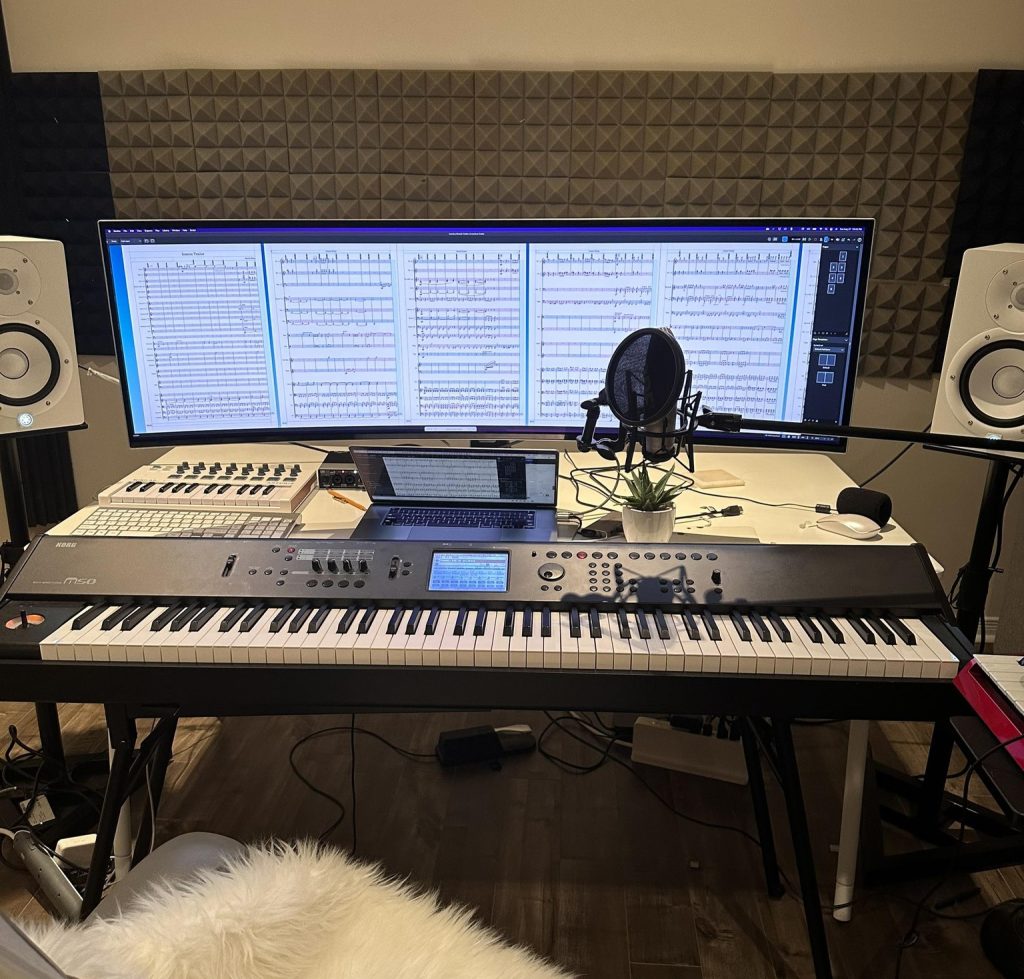
Right now, I’m elbows deep in writing, finishing a musical theatre lyric-writing course through PlayPenn that feeds directly into this show. The songs aren’t exercises. They’re for this musical, finding their way in one by one.

At the same time, I’m pulling the script together. This part feels steady. I already have the skills I need. I’m using them. Most days, the writing leads. I try to follow.

It’s becoming clear that the script and lyrics already know more than I do. They decide where the music belongs, what it needs to carry, how much underscore is needed, what kind of harmony feels honest, and how the orchestration should behave. I’m not trying to answer those questions ahead of time. I let them surface when they’re ready.

Everything that comes later, harmony, reduced score, orchestration, underscore, will be built in response to what’s already on the page. That’s on purpose. I want the music to serve the story that actually exists, not the version I imagine when I’m too far ahead of myself.

Writing first. Listening carefully. Then building outward.
That order feels right to me.

I’ve already had virtual table reads through Primary Stages, and they were invaluable. There’s nothing like hearing the work out loud to know where it breathes and where it resists. That process is on pause while I keep writing and pulling the script together. Right now, it feels more important to let the piece finish becoming itself on the page.

In terms of guidance, I’m being deliberate. Not about getting more feedback, but about getting it at the right moments.

Over the years, I’ve sought out learning wherever it was offered. I studied playwriting with Paul Peditto and attended masterclasses by writers and composers whose work has shaped me, from Benj Pasek and Justin Paul to Margaret Atwood, David Mamet, Aaron Sorkin, and Tim Rice. I’ve also read widely, from The Science of Storytelling, to Aristotle, to books that break down how musicals actually work.

I’ve pressed pause on the children’s books I’ve written. They’re ready to wait. When the time comes, I’ll bring them forward together, alongside the push to move the musical toward the stage. For now, I’m focused on creation, not release, giving this work the attention it needs before anything else is shared.

Once the rough draft is ready, I’ll return to Primary Stages for a focused development phase, shaping the piece with weekly feedback. Not to reinvent it, but to clarify and strengthen what’s already there.

When the script is finished, I aim to submit it through the Dramatists Guild for critique. By then, the goal won’t be discovery. It will be pressure-testing the whole.

That collective wisdom is in the room with me now, shaping how I approach the page. It shows up quietly in the choices I make, in what I leave alone, and in the patience I let the work have. It’s part of why I trust the process as it unfolds, even when I don’t know what comes next.

_______________________________________________________

About Imaginary Audiences 

Genre: A hybrid cinematic musical, epic in scope but grounded in human emotion, tragedy, and timeless storytelling.
About the Show
Imaginary Audiences is set between the late 1940s and the 1960s, at the intersection of Broadway and film. It’s a sweeping story carried by a timeless orchestral sound. The music borrows from the grandeur of Les Misérables and the cinematic sweep of The Greatest Showman, but also leans into the honest lyricism of Olivia Rodrigo. The score blends old and new: strings, hollow winds, brass, percussion, and hybrid synths create something that feels both expansive and intimate.
The score moves with the story, guiding the audience through moments of tenderness, turmoil, and triumph. Underneath the songs, there’s an orchestrated soundscape: the rattle of train tracks, the howl of a train, the low hum of the world itself. These sounds are woven into the music so that story and sound move together.
It’s classic and current at the same time, with the heart of Broadway and the spirit of cinema. The sound is lush and emotional, bridging different eras. With sweeping ballads and pop honesty, Imaginary Audiences honors Broadway’s golden age while reaching for the raw, unguarded heart of today’s listener.