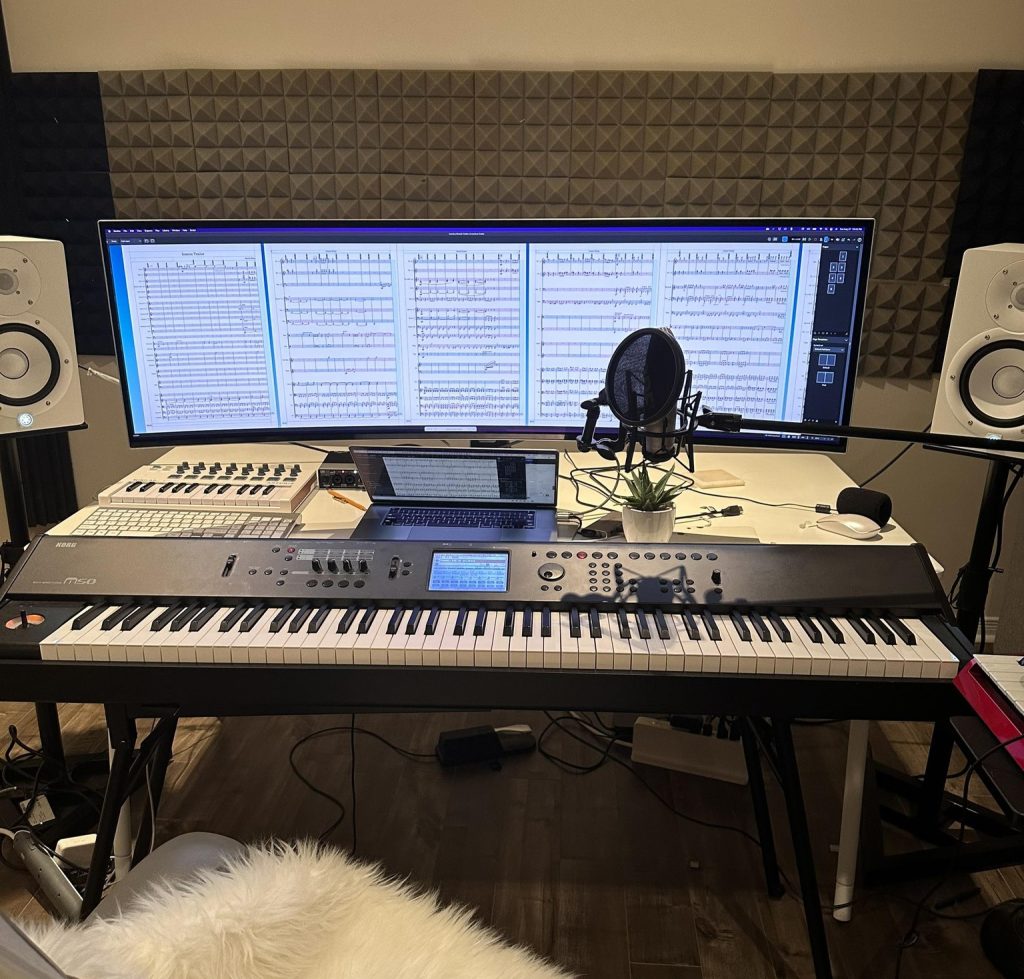
Most days, I have my head down, coffee beside me, cold by the time I notice it.
The pages are usually spread out, notes everywhere. Books, sticky tabs on my laptop, a digital notepad, and a leather-bound book for ideas I’m convinced are important, at least until I’m not.
This musical has been a long time coming.
The first song, Imaginary Audiences / This Is Your Time, came together four years ago. Everything else has been steeping since. Simon’s world didn’t arrive all at once. It surfaced in pieces, images, scraps of dialogue, unfinished melodies. All of it bubbling up in the background of daily life.
That first song came on the heels of a collaboration that changed something for me. When I shared the work, Andrew Rollins told us it made him feel as though he’d been transported back into the Lincoln Theatre, where he’d once been part of Ain’t Nothing but the Blues. I didn’t fully understand how something that had come so naturally out of me could land that way on someone from that world, especially since I had no experience writing for musical theatre. But it planted something that quietly changed the direction of my work.
During that feedback session, he suggested it might be an avenue to pursue, and that night, I couldn’t stop writing. The song that came out of it was the beginning of the musical for me.
That moment also connected me with Jeff Franzel. His encouragement mattered more than he probably knows. He helped me trust my instincts and believe in the project when it was still fragile. Andrew taught me something just as lasting, to eat the elephant one bite at a time. Stay with the work. Don’t get overwhelmed by its size. Keep moving forward, patiently.
Since 2021, the work has grown in the cracks, between raising my kids, losing my father, managing health, learning to live as a professional patient, and building a business one piece at a time. For a long stretch, the musical lived alongside everything else. It surfaced when it could. It waited when life took over.
Sometimes it waited quietly. Other times, it demanded my attention. I didn’t always have the space to follow it, but it never left. The story kept working on me, even when I wasn’t working on it.
This fall, something shifted. Time, experience, and quiet persistence finally made space for the work to step forward. The business could run. Life could hold. What I’d carried alongside everything else could finally have my full attention. What started in fragments is now a full-time effort. Not rushed. Not sudden. Just ready.
My phone is overflowing with notes. Screenshots, half-finished thoughts, things I typed late at night, popcorn ideas I was afraid would escape me. Sketchbooks are packed with musical motifs and half-finished songs. There are pages of character profiles, things I’ve learned about them slowly, over time. There was a point when it all looked scattered, but now it’s begun to settle into something I recognize.
It’s my own kind of order. Not neat. Just lived-in.
Now it feels less like falling into something new and more like moving around inside a world I already know. I still get surprised by it. But I’m not lost anymore. I know where things connect. I know which ideas belong together and which ones can wait.
Right now, I’m elbows deep in writing, finishing a musical theatre lyric-writing course through PlayPenn that feeds directly into this show. The songs aren’t exercises. They’re for this musical, finding their way in one by one.
At the same time, I’m pulling the script together. This part feels steady. I already have the skills I need. I’m using them. Most days, the writing leads. I try to follow.
It’s becoming clear that the script and lyrics already know more than I do. They decide where the music belongs, what it needs to carry, how much underscore is needed, what kind of harmony feels honest, and how the orchestration should behave. I’m not trying to answer those questions ahead of time. I let them surface when they’re ready.
Everything that comes later, harmony, reduced score, orchestration, underscore, will be built in response to what’s already on the page. That’s on purpose. I want the music to serve the story that actually exists, not the version I imagine when I’m too far ahead of myself.
Writing first. Listening carefully. Then building outward.
That order feels right to me.
I’ve already had virtual table reads through Primary Stages, and they were invaluable. There’s nothing like hearing the work out loud to know where it breathes and where it resists. That process is on pause while I keep writing and pulling the script together. Right now, it feels more important to let the piece finish becoming itself on the page.
In terms of guidance, I’m being deliberate. Not about getting more feedback, but about getting it at the right moments.
Over the years, I’ve sought out learning wherever it was offered. I studied playwriting with Paul Peditto and attended masterclasses by writers and composers whose work has shaped me, from Benj Pasek and Justin Paul to Margaret Atwood, David Mamet, Aaron Sorkin, and Tim Rice. I’ve also read widely, from The Science of Storytelling, to Aristotle, to books that break down how musicals actually work.
I’ve pressed pause on the children’s books I’ve written. They’re ready to wait. When the time comes, I’ll bring them forward together, alongside the push to move the musical toward the stage. For now, I’m focused on creation, not release, giving this work the attention it needs before anything else is shared.
Once the rough draft is ready, I’ll return to Primary Stages for a focused development phase, shaping the piece with weekly feedback. Not to reinvent it, but to clarify and strengthen what’s already there.
When the script is finished, I aim to submit it through the Dramatists Guild for critique. By then, the goal won’t be discovery. It will be pressure-testing the whole.
That collective wisdom is in the room with me now, shaping how I approach the page. It shows up quietly in the choices I make, in what I leave alone, and in the patience I let the work have. It’s part of why I trust the process as it unfolds, even when I don’t know what comes next.
_______________________________________________________